New Retirement Account Contribution Limits 2026: Maximize Your 401(k) and IRA Savings
As we navigate the ever-evolving landscape of personal finance, one constant remains paramount: the need for robust retirement planning. For many, the cornerstone of this planning revolves around understanding and leveraging the annual contribution limits for various retirement accounts. With 2026 on the horizon, financial professionals and diligent savers alike are eagerly anticipating the updated retirement contribution limits 2026. These adjustments, typically announced by the Internal Revenue Service (IRS) towards the end of the preceding year, play a critical role in shaping how much individuals can save tax-advantaged for their golden years. Staying informed about these changes is not just about compliance; it’s about optimizing your financial strategy to ensure you’re making the most of every opportunity to build a secure future.
The importance of these limits extends beyond mere numbers. They represent the ceiling for tax-deferred or tax-free growth, directly impacting the long-term wealth accumulation potential of your retirement nest egg. Whether you’re a seasoned investor or just starting your savings journey, understanding the nuances of the 2026 limits for 401(k)s, IRAs, and other qualified plans is essential. This comprehensive guide will delve into the projected retirement contribution limits 2026, offering insights into how these changes might affect your financial planning and providing actionable strategies to help you maximize your contributions. We’ll explore the various account types, discuss catch-up contributions for older savers, and highlight key considerations to ensure you’re on track for a comfortable retirement. Let’s embark on this journey to empower your financial future.
Understanding the Foundation: How Retirement Contribution Limits Are Set
Before we dive into the specifics of the retirement contribution limits 2026, it’s crucial to understand the mechanism behind their adjustment. The IRS, in conjunction with the Department of Labor and the Treasury Department, reviews and updates these limits annually. These adjustments are primarily based on inflation, measured by the Consumer Price Index (CPI), and other economic factors. The goal is to ensure that the limits keep pace with the rising cost of living, allowing individuals to maintain their purchasing power in retirement.
For example, if inflation is significant, the IRS is more likely to increase contribution limits to reflect the diminished value of money. This ensures that the tax advantages associated with retirement accounts remain meaningful. However, the increases are not always linear or guaranteed. There are specific formulas and thresholds that dictate when and by how much the limits can change. Understanding this underlying process helps us appreciate why these numbers fluctuate and why it’s so important to stay updated year after year.
Furthermore, different types of retirement accounts have different rules and limits. Employer-sponsored plans like 401(k)s, 403(b)s, and the Thrift Savings Plan (TSP) generally have higher contribution limits than individual retirement arrangements (IRAs), which include Traditional and Roth IRAs. This distinction is vital for strategic planning, as it allows individuals to prioritize which accounts to fund first, or how to allocate their savings across multiple vehicles to maximize their tax benefits and overall savings potential. The interplay between these various account types and their respective limits forms the backbone of effective retirement planning.
Projected 401(k) and 403(b) Contribution Limits for 2026
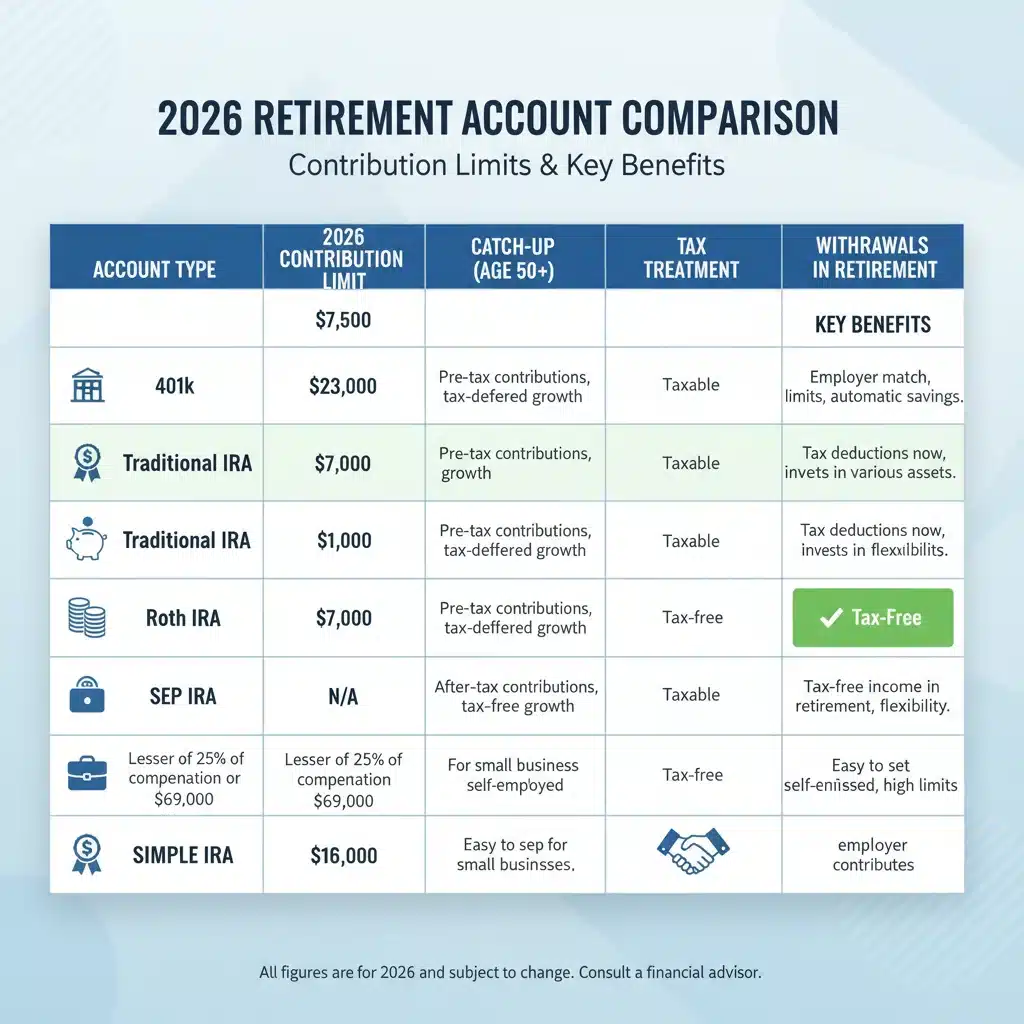
The 401(k) is arguably the most popular employer-sponsored retirement plan, offering significant tax advantages and the potential for employer matching contributions. For 2026, while official figures are yet to be released, we can make informed projections based on historical trends and current economic forecasts. Typically, the 401(k) limit sees an increase of $500 to $1,000 annually, depending on inflation. Based on current economic indicators, it is highly probable that the retirement contribution limits 2026 for 401(k)s will see a further increase.
For instance, if the limit for 2025 is $23,000, a reasonable projection for 2026 could place it in the range of $23,500 to $24,000. These figures represent the maximum amount an employee can contribute from their salary to their 401(k) plan. It’s crucial to remember that this limit applies to your elective deferrals, not to the total contributions (which include employer contributions). Employer contributions, whether matching or profit-sharing, have a separate, much higher limit, which we will discuss shortly.
Similarly, 403(b) plans, often available to employees of public schools and certain tax-exempt organizations, typically follow the same contribution limits as 401(k)s for elective deferrals. This consistency simplifies planning for individuals who might have access to both types of plans or transition between employers offering different options. Understanding these projected numbers early allows you to adjust your savings strategy proactively, ensuring you are prepared to hit the new maximum as soon as it becomes official.
Catch-Up Contributions for 401(k) and 403(b) Plans
For individuals aged 50 and over, the IRS offers a valuable provision known as catch-up contributions. These allow older savers to contribute an additional amount beyond the standard limit, providing an extra opportunity to boost their retirement savings as they approach retirement age. The catch-up contribution limit also typically adjusts with inflation, though not always in lockstep with the regular contribution limit.
While the exact 2026 catch-up contribution limit is still pending official announcement, it has historically seen incremental increases. For example, if the catch-up limit for 2025 is $7,500, we might expect a slight increase to $8,000 for 2026. This additional contribution can significantly impact your retirement readiness, especially if you started saving later in life or experienced periods of lower contributions. It’s a powerful tool for accelerating your savings and taking full advantage of the tax benefits offered by these plans. Always confirm the official figures when they are released to ensure accuracy in your planning.
Maximizing these catch-up contributions is a strategic move that can dramatically increase your retirement nest egg. For someone in their late 50s or early 60s, adding an extra several thousand dollars each year can translate into tens of thousands, or even hundreds of thousands, of dollars more in their retirement account by the time they retire, thanks to the power of compounding. This strategy is particularly effective for those who are in their peak earning years and have the disposable income to contribute more aggressively.
Projected IRA Contribution Limits for 2026: Traditional and Roth
Individual Retirement Arrangements (IRAs) – both Traditional and Roth – are critical tools for retirement savings, especially for those without access to an employer-sponsored plan or who wish to supplement their 401(k) contributions. The retirement contribution limits 2026 for IRAs are generally lower than those for 401(k)s but offer unique flexibility and tax advantages.
Historically, IRA limits also adjust based on inflation, though these increases tend to be smaller and less frequent than 401(k) limits. If the IRA limit for 2025 is $7,000, we might anticipate a modest increase to $7,500 for 2026, or it might remain unchanged if inflation doesn’t meet the necessary thresholds for an adjustment. It’s important to monitor the official IRS announcements closely for precise figures.
The choice between a Traditional IRA and a Roth IRA depends on your current income, expected future tax bracket, and eligibility. Traditional IRA contributions may be tax-deductible in the year they are made, and taxes are paid upon withdrawal in retirement. Roth IRA contributions are made with after-tax dollars, and qualified withdrawals in retirement are tax-free. Understanding your personal financial situation is key to choosing the right IRA for your needs.

IRA Catch-Up Contributions for Those 50 and Over
Similar to 401(k)s, IRAs also offer catch-up contributions for individuals aged 50 and older. This allows them to contribute an additional amount beyond the standard limit. The IRA catch-up contribution limit has typically remained constant for several years, often set at $1,000. While there’s always a possibility of an adjustment, it’s generally less frequent than the primary contribution limits.
For 2026, it is reasonable to project that the IRA catch-up contribution will remain at $1,000, bringing the total potential contribution for those aged 50 and over to $8,500 (assuming a $7,500 standard limit). This additional contribution, though smaller than the 401(k) catch-up, is still a valuable tool for boosting retirement savings, especially for those who are self-employed or have limited access to employer-sponsored plans. It’s an opportunity that should not be overlooked by eligible individuals seeking to maximize their retirement funding.
The flexibility of IRAs, combined with catch-up provisions, makes them an indispensable part of a diversified retirement strategy. Even if you contribute to a 401(k), maxing out an IRA can provide additional tax advantages and investment options. For instance, Roth IRAs have income limitations for direct contributions, but the ‘backdoor Roth’ strategy remains a viable option for high-income earners to contribute indirectly.
Other Key Retirement Account Limits for 2026
While 401(k)s and IRAs are the most common, several other retirement accounts also have contribution limits that are subject to annual adjustments. These include SEP IRAs, SIMPLE IRAs, and the overall limit for defined contribution plans.
SEP IRA Contribution Limits
Simplified Employee Pension (SEP) IRAs are popular among self-employed individuals and small business owners due to their ease of administration and high contribution limits. Contributions to a SEP IRA are made by the employer (which can be the individual themselves if self-employed) and are based on a percentage of the employee’s compensation. The maximum contribution is typically the lesser of 25% of the employee’s compensation or a specific dollar amount set by the IRS.
For 2026, we can expect the maximum dollar amount for SEP IRA contributions to increase, following the trend of other retirement plans. If the 2025 limit is $69,000, a projection for 2026 could see it rise to $70,000 or $71,000. This high limit makes SEP IRAs an excellent vehicle for self-employed individuals looking to significantly reduce their taxable income while saving for retirement. It’s important to calculate your maximum contribution carefully, as it depends on your net earnings from self-employment.
SIMPLE IRA Contribution Limits
Savings Incentive Match Plan for Employees (SIMPLE) IRAs are another option for small businesses, offering a more straightforward alternative to 401(k)s. Employees can contribute a portion of their salary, and employers are required to make either matching or non-elective contributions. The employee contribution limit for SIMPLE IRAs is generally lower than for 401(k)s.
For 2026, if the 2025 employee contribution limit for SIMPLE IRAs is $16,000, we might anticipate a modest increase to $16,500. The catch-up contribution for those aged 50 and over for SIMPLE IRAs is also subject to annual adjustment, typically an additional $3,500. These plans are a great way for small businesses to offer a retirement benefit without the administrative complexity of a full-fledged 401(k).
Overall Defined Contribution Plan Limit (401(k) + Employer Contributions)
Beyond individual employee contributions, there’s an overall limit on total contributions to defined contribution plans (like 401(k)s and 403(b)s) from all sources – employee deferrals, employer matching, and profit-sharing contributions. This limit is significantly higher and also adjusts annually with inflation.
For 2026, if the 2025 overall limit is $69,000 (or $76,500 including catch-up for those 50+), we could see this increase to approximately $70,000 or $71,000 (and $77,500 to $78,500 including catch-up). This limit is particularly relevant for highly compensated employees or business owners who have the ability to contribute substantial amounts through a combination of personal and employer contributions. Understanding this overall cap is essential for sophisticated retirement planning and for ensuring that all contributions remain within IRS guidelines.
Strategies to Maximize Your Retirement Savings in 2026
Knowing the retirement contribution limits 2026 is only half the battle; the other half is implementing effective strategies to utilize them fully. Here are several actionable steps you can take to maximize your retirement savings in the coming year:
1. Automate Your Contributions
One of the simplest yet most effective strategies is to automate your contributions. Set up automatic deductions from your paycheck for your 401(k) or automatic transfers from your checking account to your IRA. This ‘set it and forget it’ approach ensures consistent saving and helps you avoid the temptation to spend money that could be earmarked for retirement. Automation removes the psychological barrier to saving and makes it a routine part of your financial life.
2. Aim for the Max, Especially If You’re 50+
If your financial situation allows, always aim to contribute the maximum allowable amount to your retirement accounts. For 401(k)s, this means hitting the standard limit and, if eligible, the catch-up contribution. The same applies to IRAs. Every dollar contributed up to the limit is a dollar that benefits from tax advantages and the power of compound growth. Over decades, these maximized contributions can lead to a significantly larger retirement fund.
3. Don’t Leave Employer Matching Money on the Table
If your employer offers a 401(k) match, contribute at least enough to receive the full matching contribution. This is essentially free money and represents an immediate, guaranteed return on your investment. Failing to contribute enough to get the full match is like turning down a pay raise. Prioritize reaching this threshold before considering other savings vehicles.
4. Diversify Your Retirement Accounts
Consider contributing to multiple types of retirement accounts to take advantage of their unique benefits. For example, you might contribute to your 401(k) up to the employer match, then fully fund a Roth IRA (if eligible), and then return to contributing more to your 401(k) up to the maximum. This diversification can offer tax flexibility in retirement, allowing you to draw from different accounts based on your tax situation at that time.
5. Understand and Utilize Backdoor Roth IRAs
For high-income earners who exceed the income limits for direct Roth IRA contributions, the ‘backdoor Roth’ strategy remains a popular and legal way to fund a Roth IRA. This involves contributing to a Traditional IRA with after-tax dollars and then immediately converting it to a Roth IRA. While it requires careful execution and understanding of the pro-rata rule if you have existing pre-tax IRA money, it’s an excellent way to gain access to tax-free growth and withdrawals in retirement.
6. Regularly Review and Adjust Your Strategy
Your financial situation, career path, and the economy are constantly changing. Make it a habit to review your retirement savings strategy at least once a year, preferably after the new contribution limits are announced. This allows you to adjust your contributions, rebalance your portfolio, and ensure your strategy aligns with your current goals and the latest IRS regulations. A financial advisor can be invaluable in this process.
7. Consider a Health Savings Account (HSA) as a Retirement Tool
For those with high-deductible health plans (HDHPs), a Health Savings Account (HSA) offers a triple tax advantage: tax-deductible contributions, tax-free growth, and tax-free withdrawals for qualified medical expenses. If you don’t use the funds for medical expenses in the short term, an HSA can function as a stealth retirement account. Once you reach age 65, you can withdraw funds for any purpose without penalty, though they will be subject to income tax if not used for qualified medical expenses. The contribution limits for HSAs also adjust annually, and they represent another powerful tool in your overall retirement strategy.
The Impact of Inflation and Economic Factors on 2026 Limits
The economy plays a significant role in determining the retirement contribution limits 2026. High inflation, as measured by the Consumer Price Index for All Urban Consumers (CPI-U), typically leads to larger increases in limits. This is because the IRS aims to maintain the purchasing power of retirement savings. However, economic downturns or periods of low inflation might result in smaller increases or even stagnation of limits for certain account types.
Beyond inflation, wage growth also influences the calculation of some limits, particularly for employer-sponsored plans and the overall defined contribution limit. Strong wage growth can support higher limits, reflecting individuals’ increased capacity to save. Understanding these macroeconomic forces provides context for why limits change and helps in anticipating future adjustments.
It’s also worth noting that legislative changes can occasionally impact retirement contribution limits, though annual adjustments are primarily driven by inflation. While major legislative overhauls are less frequent, they can introduce new types of accounts, modify existing rules, or significantly alter contribution caps. Staying informed about potential legislative developments is another layer of proactive retirement planning.
Key Takeaways for Your 2026 Retirement Planning
As we anticipate the official announcement of the retirement contribution limits 2026, here are the key takeaways to keep in mind for your financial planning:
- Stay Informed: Regularly check official IRS announcements for the precise 2026 contribution limits. These are typically released in late October or early November of the preceding year.
- Proactive Planning: Use projected limits to start planning your contributions early. Adjust your payroll deductions or automatic transfers as soon as the official numbers are confirmed.
- Maximize All Opportunities: Aim to contribute the maximum allowable to your 401(k) and IRA. If eligible, always utilize catch-up contributions. Don’t leave employer matching contributions on the table.
- Diversify and Strategize: Consider using a combination of different retirement accounts (401(k), Traditional IRA, Roth IRA, HSA) to optimize tax benefits and investment flexibility.
- Seek Professional Advice: If your financial situation is complex or you’re unsure about the best strategy, consult with a qualified financial advisor. They can help you navigate the intricacies of retirement planning and ensure you’re making the most informed decisions for your future.
Your retirement security is a journey, not a destination. Each year brings new opportunities and challenges. By staying informed about the retirement contribution limits 2026 and implementing smart savings strategies, you are taking crucial steps towards building the comfortable and secure retirement you envision. Start planning today, contribute consistently, and watch your nest egg grow.