Roth vs. Traditional IRA in 2026: Which Retirement Account Offers Better Tax Advantages for Your Income Bracket?
Planning for retirement is one of the most critical financial decisions you’ll ever make. As we look towards 2026, understanding the nuances of various retirement vehicles becomes even more essential. Among the most popular options, the Roth IRA and the Traditional IRA stand out, each offering distinct tax advantages designed to benefit different financial situations. The choice between a Roth vs. Traditional IRA can significantly impact your long-term wealth accumulation and your tax burden in retirement. This comprehensive guide will delve deep into the mechanics of both accounts, analyze their tax implications for various income brackets, and help you determine which option aligns best with your financial goals for 2026 and beyond.
The landscape of personal finance is constantly evolving, with tax laws and economic conditions shifting. Therefore, revisiting your retirement strategy periodically, especially when a new year approaches, is a prudent move. For 2026, the fundamental differences between Roth and Traditional IRAs remain: one offers tax-deductible contributions now, while the other provides tax-free withdrawals later. But which one is truly better for you? The answer isn’t universal; it depends heavily on your current income, your projected income in retirement, and your overall tax philosophy.
Understanding the Basics: Roth IRA Explained
The Roth IRA, named after Senator William Roth, is a retirement savings plan that offers a unique tax advantage: your contributions are made with after-tax dollars, meaning you don’t get an upfront tax deduction. However, the magic happens in retirement. All qualified withdrawals, including both your contributions and any earnings, are completely tax-free. This feature makes the Roth IRA particularly attractive to individuals who anticipate being in a higher tax bracket during retirement than they are today.
Key Features of a Roth IRA:
- After-Tax Contributions: You contribute money that has already been taxed.
- Tax-Free Withdrawals in Retirement: Qualified distributions are free from federal income tax (and often state income tax, depending on your state). To be qualified, distributions must be made after age 59½ and after the account has been open for at least five years.
- No Required Minimum Distributions (RMDs) for the Original Owner: Unlike Traditional IRAs, Roth IRAs do not require you to start taking distributions at a certain age (currently 73), allowing your money to continue growing tax-free for as long as you live. This makes Roth IRAs an excellent estate planning tool.
- Contribution Limits: For 2026, while official limits are yet to be announced, they typically adjust for inflation. For reference, in 2024, the limit was $7,000, with an additional catch-up contribution of $1,000 for those aged 50 and over.
- Income Limitations: Eligibility to contribute directly to a Roth IRA is subject to income phase-outs. If your modified adjusted gross income (MAGI) exceeds certain thresholds, your ability to contribute directly may be reduced or eliminated. However, the ‘backdoor Roth IRA’ strategy can be an option for high-income earners.
- Flexibility: You can withdraw your contributions (but not earnings) at any time, tax-free and penalty-free, as they’ve already been taxed. This offers a degree of liquidity not found in Traditional IRAs for early withdrawals of contributions.
The Roth IRA is often favored by younger individuals early in their careers who expect their income, and thus their tax bracket, to increase significantly over time. It’s also a strong contender for those who believe tax rates will be higher in the future, making tax-free withdrawals in retirement incredibly valuable.
Understanding the Basics: Traditional IRA Explained
The Traditional IRA is the classic retirement savings vehicle, offering a different set of tax advantages compared to its Roth counterpart. With a Traditional IRA, contributions may be tax-deductible in the year they are made, effectively lowering your taxable income today. The money then grows tax-deferred, meaning you don’t pay taxes on the investment gains until you withdraw the money in retirement. This setup is particularly appealing to individuals who are currently in a higher tax bracket and expect to be in a lower tax bracket during their retirement years.
Key Features of a Traditional IRA:
- Pre-Tax or After-Tax Contributions: Contributions can be tax-deductible if you (and your spouse, if filing jointly) are not covered by a retirement plan at work, or if your income is below certain thresholds if you are covered. If you are covered by a workplace plan and your income exceeds certain limits, your contributions may be non-deductible, but still grow tax-deferred.
- Tax-Deferred Growth: Your investments grow without being taxed annually. Taxes are only paid when you take distributions in retirement.
- Taxable Withdrawals in Retirement: All deductible contributions and all earnings are taxed as ordinary income upon withdrawal in retirement. Non-deductible contributions are not taxed upon withdrawal, but their earnings are.
- Required Minimum Distributions (RMDs): You generally must begin taking distributions from your Traditional IRA once you reach a certain age (currently 73), regardless of whether you need the money.
- Contribution Limits: Similar to Roth IRAs, Traditional IRA contribution limits for 2026 will likely be adjusted for inflation. (For 2024, it was $7,000, plus an additional $1,000 catch-up contribution for those aged 50 and over).
- No Income Limitations for Contributions: Unlike Roth IRAs, there are no income limits that prevent you from contributing to a Traditional IRA. However, there are income limits that affect whether your contributions are tax-deductible.
The Traditional IRA is often the preferred choice for those in their peak earning years, who are looking to reduce their current taxable income. It’s also suitable for individuals who anticipate a significant drop in their income during retirement, perhaps due to less need for income or moving into a lower tax bracket.
Roth vs. Traditional IRA: The Core Tax Advantage Comparison
The fundamental difference between a Roth vs. Traditional IRA boils down to when you pay taxes: now or later. This choice is deeply intertwined with your current and projected future tax brackets.
Pay Taxes Now (Roth IRA):
With a Roth IRA, you forgo a current tax deduction. This means your taxable income today isn’t reduced by your contributions. However, the trade-off is immense: all qualified withdrawals in retirement are tax-free. This strategy is advantageous if:
- You expect to be in a higher tax bracket in retirement: If you’re early in your career, have a relatively low income now, but anticipate significant career growth and higher earnings in the future, paying taxes on your contributions today at a lower rate is preferable to paying taxes on potentially much larger withdrawals at a higher rate later.
- You believe tax rates will increase in the future: If you foresee a general rise in income tax rates across the board, locking in tax-free withdrawals with a Roth IRA mitigates the risk of higher future taxes on your retirement savings.
- You want tax-free income in retirement: Having a source of tax-free income can provide significant flexibility in retirement, allowing you to manage your overall taxable income more effectively and potentially keep you in a lower tax bracket for other income sources.
Pay Taxes Later (Traditional IRA):
A Traditional IRA offers an immediate tax deduction for eligible contributions, reducing your current taxable income. In return, your withdrawals in retirement will be taxed as ordinary income. This strategy is beneficial if:
- You are currently in a higher tax bracket: If you’re in your peak earning years and paying a significant portion of your income in taxes, deducting your IRA contributions can lead to substantial immediate tax savings. The idea is that you’re paying taxes at a lower rate in retirement.
- You expect to be in a lower tax bracket in retirement: Many people anticipate their income to decrease in retirement. If you believe your post-retirement income will place you in a lower tax bracket than your current one, deferring taxes makes sense. You get the deduction now at your higher rate and pay taxes later at your lower rate.
- You want to reduce your current taxable income: Beyond just tax bracket considerations, a Traditional IRA deduction can help reduce your adjusted gross income (AGI), which can have a ripple effect on your eligibility for other tax credits or deductions.
The decision hinges on a prediction: will your tax rate be higher now or in retirement? While no one has a crystal ball, you can make an educated guess based on your career trajectory, expected retirement lifestyle, and current tax laws.
Impact of Income Brackets on Your Decision in 2026
Your current and projected income brackets are arguably the most crucial factors in deciding between a Roth vs. Traditional IRA. Let’s break down how different income levels might sway your choice for 2026.
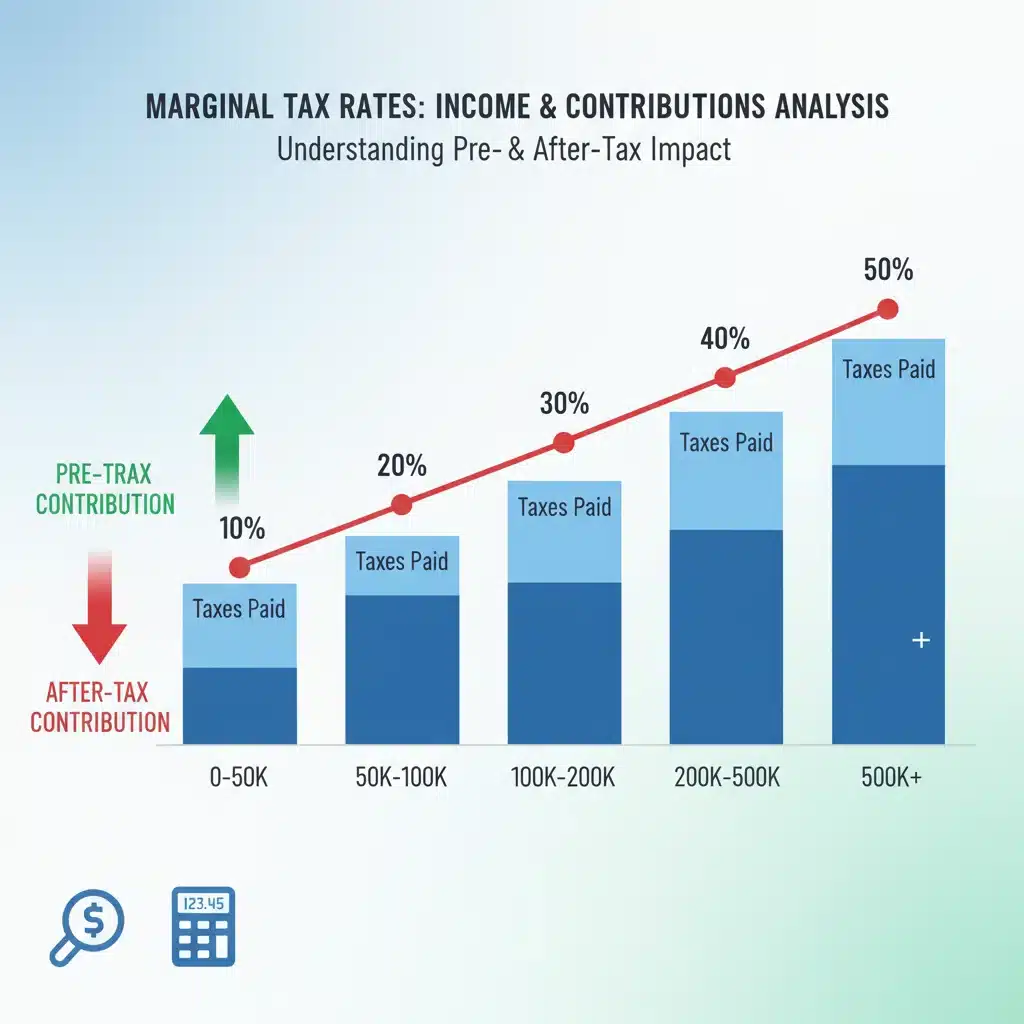
Low to Moderate Income Earners (e.g., 10% – 22% marginal tax brackets):
If you are currently in a lower tax bracket, the immediate tax deduction offered by a Traditional IRA might not be as impactful. For example, if you’re in the 12% bracket, a $7,000 deduction would save you $840 in taxes. While not insignificant, the long-term benefit of tax-free withdrawals from a Roth IRA could be far greater if your income grows substantially over your career. For these individuals, a Roth IRA is often the more powerful choice. You pay taxes now at a low rate, and all future growth and withdrawals are tax-free, potentially saving you a significant amount if you climb into higher tax brackets later on.
Mid to High Income Earners (e.g., 24% – 32% marginal tax brackets):
For those in the middle to higher tax brackets, the immediate tax deduction from a Traditional IRA becomes much more attractive. A $7,000 deduction in the 24% bracket saves you $1,680 today, and in the 32% bracket, it saves you $2,240. These are tangible savings that can be reinvested or used for other financial goals. If you anticipate your income dropping in retirement (e.g., you move from the 32% bracket to the 22% bracket), the Traditional IRA can be highly beneficial. However, if you expect to maintain a high income in retirement or believe tax rates will generally increase, a Roth IRA (perhaps via the backdoor method if you exceed direct contribution limits) could still be a strong contender for its tax-free growth.
High Income Earners (e.g., 35% – 37% marginal tax brackets):
Individuals in the highest tax brackets often find the upfront deduction of a Traditional IRA very appealing. The tax savings are substantial. However, high-income earners often face income limitations for direct Roth IRA contributions. This is where the ‘backdoor Roth IRA’ strategy comes into play. This involves contributing non-deductible funds to a Traditional IRA and then converting them to a Roth IRA. While the initial contribution isn’t deductible, the subsequent growth in the Roth is tax-free. For these individuals, a combination strategy or utilizing employer-sponsored plans like a Roth 401(k) alongside a Traditional IRA might be optimal.
Other Factors to Consider for Your Roth vs. Traditional IRA Decision
While tax brackets are paramount, several other factors should influence your Roth vs. Traditional IRA decision for 2026.
1. Future Tax Rate Predictions:
This is the ultimate crystal ball question. Do you believe tax rates will be higher or lower in the future? Many economists and policy analysts suggest that current tax rates are historically low and may need to rise in the future to address national debt. If you subscribe to this view, locking in tax-free withdrawals with a Roth IRA becomes a very compelling argument.
2. Access to Funds Before Retirement:
Roth IRAs offer a unique advantage here: you can withdraw your contributions (not earnings) at any time, tax-free and penalty-free. This provides a level of emergency fund access or flexibility that Traditional IRAs do not without incurring penalties and taxes on early withdrawals (unless an exception applies).
3. Estate Planning:
Roth IRAs have no RMDs for the original owner, allowing the account to grow tax-free throughout your lifetime and then be passed on to beneficiaries, who will also benefit from tax-free withdrawals (though they will eventually have RMDs). Traditional IRAs, with their RMDs, force distributions and thus taxation, reducing the amount that can be passed on tax-deferred.
4. Eligibility for Other Tax Credits/Deductions:
A Traditional IRA contribution can lower your Adjusted Gross Income (AGI). A lower AGI can potentially qualify you for other tax credits or deductions that have income limitations, such as the Child Tax Credit, education credits, or even lower Medicare premiums. This indirect benefit can sometimes tip the scales in favor of a Traditional IRA.
5. Your Overall Financial Picture:
Consider your entire retirement portfolio. Do you have a 401(k) or other employer-sponsored plans? Are you contributing to a Roth 401(k) or a Traditional 401(k)? Diversifying across different tax treatments (some pre-tax, some after-tax) can provide flexibility in retirement to manage your tax bill year by year. For instance, if you have a Traditional 401(k), a Roth IRA might provide a nice balance.
Strategies for Optimizing Your IRA Choice in 2026
The decision isn’t always an either/or. Here are some strategies to consider:
1. The Backdoor Roth IRA:
If your income exceeds the limits for direct Roth IRA contributions, you can still get money into a Roth. This involves contributing non-deductible funds to a Traditional IRA and then converting them to a Roth IRA. This is a legitimate strategy, but it requires careful execution, especially if you have existing pre-tax Traditional IRA balances (the pro-rata rule).
2. The Mega Backdoor Roth:
For those with a 401(k) that allows after-tax contributions and in-service distributions, the mega backdoor Roth allows you to contribute a significant amount of after-tax money to your 401(k) and then convert it to a Roth IRA, far exceeding the standard IRA contribution limits. This is a more advanced strategy and depends on your employer’s plan rules.
3. Roth Conversions:
Even if you’ve primarily contributed to a Traditional IRA, you can convert all or part of it to a Roth IRA. You’ll pay taxes on the converted amount in the year of conversion, but all future growth and qualified withdrawals from the Roth will be tax-free. This can be strategic during years when you anticipate being in a lower tax bracket (e.g., during a career break, early retirement before Social Security, or when you have significant tax deductions).

4. Diversify Your Tax Buckets:
Many financial advisors recommend having money in different ‘tax buckets’: taxable accounts (brokerage accounts), tax-deferred accounts (Traditional IRA, 401(k)), and tax-free accounts (Roth IRA, Roth 401(k)). This diversification gives you maximum flexibility in retirement to choose which accounts to draw from, allowing you to manage your annual income and minimize your tax liability.
Conclusion: Making the Best Choice for Your Future
The decision between a Roth vs. Traditional IRA in 2026 is a personalized one, with no single right answer for everyone. It requires a thoughtful evaluation of your current financial situation, your career trajectory, your income expectations in retirement, and your outlook on future tax rates. If you’re young and expect your income to rise, or if you believe tax rates will increase, a Roth IRA often holds the edge. If you’re in your peak earning years and anticipate a lower income in retirement, the immediate tax benefits of a Traditional IRA can be very compelling.
It’s also important to remember that your choice isn’t necessarily permanent. You can utilize strategies like Roth conversions or even contribute to both types of accounts in different stages of your life or in different years, depending on your circumstances. The key is to be proactive, understand the implications of each choice, and ideally, consult with a qualified financial advisor. They can help you model various scenarios, navigate the complexities of tax laws, and ensure your retirement savings strategy is optimized for your unique financial journey in 2026 and well into your golden years.