Maximize Your Social Security Benefits: Insider Strategies to Increase Your Payout by Up to 8% in 2026
For many Americans, Social Security represents a cornerstone of their retirement income. It’s not just a supplement; for millions, it’s a vital lifeline. However, understanding the intricacies of the Social Security system can feel like navigating a labyrinth. With potential changes and cost-of-living adjustments (COLAs) always on the horizon, like the anticipated adjustments for 2026, it’s more crucial than ever to grasp how to effectively maximize social security benefits. This comprehensive guide will delve into insider strategies that could potentially boost your annual payout by up to 8% or more, ensuring you make the most of your hard-earned contributions.
Understanding the Basics of Social Security Benefits
Before we dive into advanced strategies to maximize social security, let’s briefly review the fundamentals. Social Security benefits are calculated based on your highest 35 years of earnings. The more you earn (up to the annual taxable maximum) and the longer you work, the higher your potential benefit will be. Your Primary Insurance Amount (PIA) is the benefit you’re entitled to at your Full Retirement Age (FRA).
What is Your Full Retirement Age (FRA)?
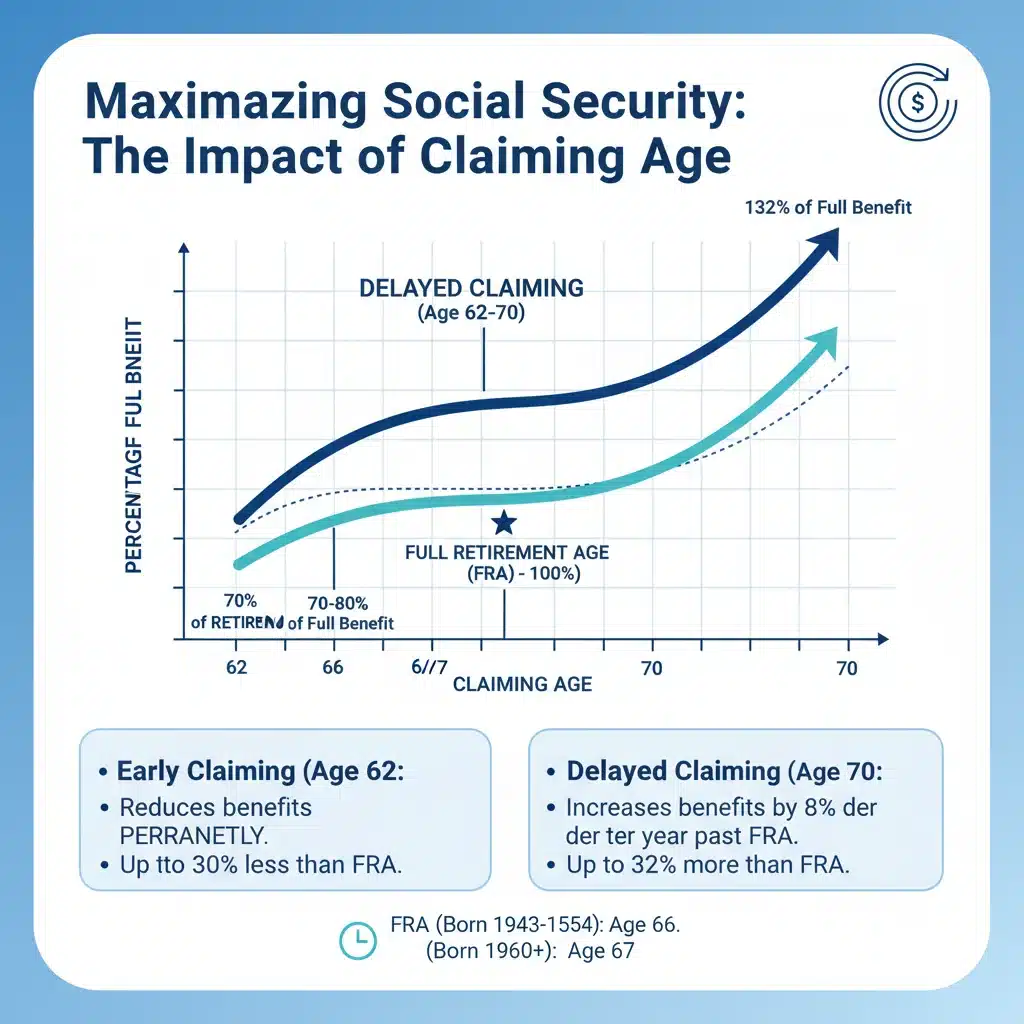
Your FRA is a critical factor in determining your Social Security payout. It’s the age at which you’re eligible to receive 100% of your PIA. For those born in 1943 through 1954, FRA is 66. It gradually increases for those born later, reaching age 67 for anyone born in 1960 or later. Claiming benefits before your FRA results in a permanent reduction, while delaying beyond your FRA can lead to significant increases.
The Power of Delayed Claiming: An 8% Annual Increase
This is perhaps the most impactful strategy to maximize social security. For every year you delay claiming benefits past your FRA, up to age 70, your benefit amount increases by a certain percentage. This is known as Delayed Retirement Credits (DRCs). For those born in 1943 or later, this increase is 8% per year. Think about that: waiting just one year past your FRA could mean an 8% higher annual payout for the rest of your life!
For example, if your FRA is 67 and your PIA is $2,000 per month, delaying until age 68 would increase your monthly benefit to $2,160 (an 8% increase). Delaying until age 70 would result in a 24% increase over your FRA benefit, making your monthly check $2,480. This compounding effect is a powerful tool to maximize social security, especially for those who are healthy and anticipate a long retirement.
Strategic Claiming Ages: When to Make Your Move
Deciding when to start receiving Social Security benefits is one of the most important financial decisions you’ll make in retirement. There’s no one-size-fits-all answer, as the optimal claiming age depends on various factors, including your health, financial needs, other income sources, and marital status.
Claiming Early (Age 62): The Trade-Off
You can start receiving Social Security benefits as early as age 62. However, claiming early results in a permanent reduction of your monthly benefit. The reduction can be substantial, up to 30% if your FRA is 67. While it provides income sooner, it significantly reduces your lifetime benefits, making it harder to maximize social security.
When early claiming might make sense:
- Health issues: If you have a serious health condition and a shorter life expectancy, taking benefits early might be prudent to receive more total benefits over your lifetime.
- Immediate financial need: If you’ve lost your job, have no other income, and need funds to cover essential living expenses.
- Bridging the gap: To cover expenses until a pension or other retirement income begins.
Claiming at Full Retirement Age (FRA): The Standard Approach
Claiming at your FRA means you receive 100% of your PIA. This is a common choice, striking a balance between receiving benefits earlier and avoiding the permanent reductions associated with early claiming. For many, it feels like the ‘safe’ option, but it often leaves significant money on the table when aiming to maximize social security.
Claiming Late (Up to Age 70): The Optimal Strategy for Many
As discussed, delaying beyond your FRA, up to age 70, offers the largest possible monthly benefit due to DRCs. This strategy is particularly powerful for:
- Individuals with good health: If you expect to live a long life, the higher monthly payments will accumulate into a much larger total payout over your lifetime.
- Those with sufficient retirement savings: If you have other assets (401(k)s, IRAs, savings) to cover your living expenses until age 70, you can let your Social Security benefit grow.
- High earners: If you had high earnings throughout your career, the 8% annual increase on a larger PIA can be substantial.
Spousal and Survivor Benefits: Unlocking Additional Payouts
Social Security isn’t just about your own work record. Spousal and survivor benefits offer significant opportunities to maximize social security, especially for married couples, divorced individuals, and widows/widowers.
Spousal Benefits: A Key for Married Couples
If you are married, you may be eligible to receive a spousal benefit based on your spouse’s work record. This benefit can be up to 50% of your spouse’s PIA. To qualify, your spouse must have already filed for their own retirement benefits. You must also be at least 62 years old, or any age if you are caring for a child under age 16 or disabled.
Key considerations for spousal benefits:
- Your own benefit vs. spousal benefit: The Social Security Administration (SSA) will always pay you your own earned benefit first. If your spousal benefit is higher, they will pay you a combination that equals the higher spousal amount. You cannot receive both your full benefit and a full spousal benefit simultaneously.
- FRA for spousal benefits: To receive 50% of your spouse’s PIA, you must claim at your own FRA. Claiming spousal benefits early will also result in a permanent reduction.
- Coordinating claiming strategies: For couples, strategic coordination is crucial to maximize social security for the household. Often, the higher earner delays claiming until age 70 to maximize their benefit (which also maximizes the potential survivor benefit), while the lower earner might claim their own benefit or a spousal benefit earlier, depending on their individual PIA and FRA.
Survivor Benefits: A Lifeline for Widows and Widowers
If your spouse passes away, you may be eligible for survivor benefits based on their work record. A widow or widower can receive 100% of their deceased spouse’s benefit amount if they claim at their own FRA. If they claim earlier, the benefit will be reduced, but can start as early as age 60 (or age 50 if disabled).
Important survivor benefit strategies:
- Switching strategies: A common strategy for a widow/widower is to claim their own reduced retirement benefit early (e.g., at age 62) and then switch to their full survivor benefit at their FRA, or vice-versa, depending on which benefit is higher and how to best maximize social security over time.
- Impact of deceased spouse’s claiming age: The amount of the survivor benefit is based on what the deceased spouse was receiving or was entitled to receive at the time of death. This means if the deceased spouse delayed claiming until age 70, the survivor benefit would be significantly higher.
Divorced Spousal Benefits: Don’t Overlook Them
Even if you’re divorced, you may still be eligible for benefits based on your ex-spouse’s work record. This applies if:
- Your marriage lasted 10 years or longer.
- You are currently unmarried.
- You are age 62 or older.
- Your ex-spouse is entitled to Social Security retirement or disability benefits.
- The amount you would receive based on your own work record is less than the amount you would receive based on your ex-spouse’s record.
Crucially, your ex-spouse does not need to know you are claiming, and it does not affect their benefits or the benefits of their current spouse. This is a powerful, often overlooked, way to maximize social security for many individuals.
Navigating the Earnings Test and Taxation
While aiming to maximize social security, it’s essential to understand how working in retirement can affect your benefits, as well as how your benefits might be taxed.
The Earnings Test: Beware If You Claim Early and Work
If you claim benefits before your FRA and continue to work, your benefits may be reduced if your earnings exceed certain limits. This is known as the Social Security earnings test. In 2024, if you are under FRA, the SSA deducts $1 from your benefits for every $2 you earn above $22,320. In the year you reach FRA, the deduction is $1 for every $3 you earn above a higher limit ($59,520 in 2024) until the month you reach FRA. Once you reach your FRA, the earnings test no longer applies, and you can earn as much as you want without your benefits being reduced.
Important note: Any benefits withheld due to the earnings test are not lost forever. When you reach your FRA, your monthly benefit will be recalculated to account for the withheld benefits, effectively increasing your future payments. However, it’s still a factor to consider in your overall strategy to maximize social security.
Taxation of Social Security Benefits
Depending on your combined income, a portion of your Social Security benefits may be subject to federal income tax. Your ‘combined income’ is the sum of your adjusted gross income (AGI), any tax-exempt interest, and one-half of your Social Security benefits.
- Up to 50% of benefits taxable: If your combined income is between $25,000 and $34,000 for an individual, or between $32,000 and $44,000 for a married couple filing jointly.
- Up to 85% of benefits taxable: If your combined income is above $34,000 for an individual, or above $44,000 for a married couple filing jointly.
Some states also tax Social Security benefits. Understanding these tax implications is crucial for holistic retirement planning and ensuring you truly maximize social security net payouts.

Advanced Strategies to Potentially Boost Your Payout in 2026
Beyond the fundamental claiming ages and spousal benefits, there are several advanced tactics to consider as you plan to maximize social security, especially with an eye towards 2026 and beyond.
1. Reconsidering a Filed Claim (Do-Over Strategy)
If you claimed benefits early and now regret it, you might have a ‘do-over’ option. You can withdraw your application for benefits within 12 months of first claiming and repay all benefits you’ve received. This allows you to refile later at a higher age, taking advantage of DRCs to maximize social security. This option can only be exercised once in a lifetime.
Alternatively, if you’ve already passed the 12-month window but are past your FRA, you can suspend your benefits. This allows your benefits to grow by 8% per year until age 70, at which point they will automatically resume at the higher amount. This can be a great way to maximize social security if your financial situation improves later in retirement.
2. Maximizing Your Earnings Record
Remember, your benefits are based on your highest 35 years of earnings. If you have fewer than 35 years of earnings, or if some of your early career years had very low earnings, working a few more years, even part-time, could replace those low-earning years with higher ones. This recalculation could lead to a higher PIA and thus help you to maximize social security.
3. Understanding the Cost-of-Living Adjustment (COLA) for 2026
Social Security benefits are adjusted annually based on the Cost-of-Living Adjustment (COLA) to help maintain purchasing power. While the COLA for 2026 won’t be announced until late 2025, understanding how it works is vital. A higher COLA means a larger percentage increase to your benefits. Delaying your claim means that when you do start receiving benefits, the COLA increases will be applied to an already larger base amount, compounding your gains and further helping you to maximize social security.
4. The Importance of Financial Planning and Professional Advice
Navigating the complex world of Social Security and retirement planning can be daunting. A qualified financial advisor specializing in retirement can help you analyze your specific situation, project different claiming scenarios, and integrate your Social Security strategy with your overall financial plan. They can help you understand the nuances of spousal benefits, survivor benefits, and the earnings test in the context of your unique circumstances, ensuring you truly maximize social security.
Preparing for 2026: What to Consider Now
As we look towards 2026, it’s never too early to start planning. Here are actionable steps you can take today to prepare:
- Review your Social Security statement: Access your statement online at ssa.gov/myaccount. This statement provides an estimate of your benefits at different claiming ages and helps you verify your earnings record.
- Estimate your life expectancy: Be realistic about your health and family history. This is a critical factor in determining whether early or delayed claiming will yield more total benefits over your lifetime.
- Assess your retirement income needs: How much money will you need to live comfortably in retirement? Factor in healthcare costs, housing, travel, and everyday expenses. This will help you determine how much you need Social Security to contribute.
- Consult with a financial advisor: As mentioned, a professional can provide personalized guidance to help you maximize social security in conjunction with your other retirement assets.
- Stay informed about legislative changes: While major overhauls are rare, minor legislative adjustments or policy changes can occur. Keep an eye on news from the SSA to stay abreast of any developments that might impact your benefits.
Common Misconceptions About Social Security
To truly maximize social security, it’s important to dispel some common myths:
- Myth: Social Security will run out. While the program faces long-term funding challenges, it’s not going to disappear. Without congressional action, it might only be able to pay a reduced percentage of promised benefits in the future, but it will not run out entirely.
- Myth: My benefits will automatically start at FRA. You must actively apply for Social Security benefits. They do not start automatically, even if you reach your FRA.
- Myth: Working after claiming means I lose all my benefits. As discussed with the earnings test, benefits may be reduced, but they are not entirely lost and are often recouped later.
- Myth: Spousal benefits reduce my spouse’s benefits. Claiming spousal benefits based on your spouse’s record does not reduce their own benefit amount.
Conclusion: Take Control of Your Social Security Future
Social Security is a complex but incredibly valuable component of your retirement plan. By understanding the rules, strategically choosing your claiming age, exploring spousal and survivor benefits, and staying informed, you can significantly maximize social security payouts. The difference between an uninformed decision and a strategic one could amount to tens, or even hundreds, of thousands of dollars over your retirement. Don’t leave money on the table. Start planning today to ensure you secure the highest possible benefits for a comfortable and financially secure future.