Federal Reserve’s Latest Statement: Interest Rate Outlook for the Next 6 Months Remains at 5.25%
In a highly anticipated announcement that sent ripples across global financial markets, the Federal Reserve has confirmed its decision to maintain the benchmark federal funds rate at its current level of 5.25%. This critical pronouncement outlines the central bank’s monetary policy stance for the foreseeable future, specifically projecting that the Fed interest rates will hold steady for at least the next six months. This continuity in policy comes after a period of aggressive rate hikes aimed at taming persistent inflation, and it signals a phase of watchful waiting as the Fed assesses the cumulative impact of its past actions on the broader economy. Understanding the implications of this decision is paramount for investors, businesses, and consumers alike, as it directly influences everything from borrowing costs to investment returns and overall economic stability. The Federal Reserve’s commitment to a 5.25% rate for an extended period suggests a delicate balance between curbing inflation and avoiding an overly restrictive stance that could trigger an economic downturn. This article will delve deep into the rationale behind the Fed’s decision, explore the economic indicators that influenced this outlook, and analyze the potential consequences for various sectors of the economy, providing a comprehensive overview of what this sustained interest rate means for the financial landscape.
The Rationale Behind the Steady Fed Interest Rates
The Federal Reserve’s decision to keep the federal funds rate at 5.25% is not made in a vacuum. It is the culmination of careful analysis of a multitude of economic data points, ongoing assessments of inflationary pressures, and a strategic outlook on economic growth. The primary mandate of the Fed is to foster maximum employment and price stability. In recent years, the focus has heavily shifted towards price stability, given the surge in inflation post-pandemic. The series of aggressive rate hikes initiated by the Fed over the past two years was a direct response to this inflationary environment, aiming to cool down an overheating economy by making borrowing more expensive and thereby reducing demand. The current pause at 5.25% suggests that the Federal Open Market Committee (FOMC) believes its previous actions are working as intended, and that the economy is on a path towards achieving the Fed’s 2% inflation target without significant further tightening. This stability in Fed interest rates reflects a cautious optimism that inflation is indeed decelerating, even if not yet fully at target, and that the labor market, while showing some signs of cooling, remains robust enough to withstand the current monetary policy settings. The committee likely observed a slowdown in consumer spending, a moderation in wage growth, and a gradual easing of supply chain pressures, all contributing to a more balanced economic environment. However, the decision to hold for six months also underscores a recognition that the fight against inflation is not yet over, and that vigilance is still required to ensure that price pressures do not re-emerge. The Fed’s forward guidance emphasizes data dependency, meaning that while the current outlook is for stability, any significant shifts in economic data could prompt a reassessment of this position. This strategic pause allows the Fed to observe the lagged effects of its previous hikes, which can take several quarters to fully manifest across the economy. It also provides businesses and consumers with a degree of predictability, enabling better financial planning in an otherwise uncertain economic climate. The transparency in their communication regarding the sustained Fed interest rates at 5.25% aims to manage market expectations and prevent undue volatility, reinforcing the central bank’s commitment to a clear and consistent monetary policy framework. This period of stability is crucial for allowing the economy to absorb the previous adjustments and for the Fed to gather more definitive evidence of sustained progress towards its dual mandate objectives.
Economic Indicators Influencing the Decision
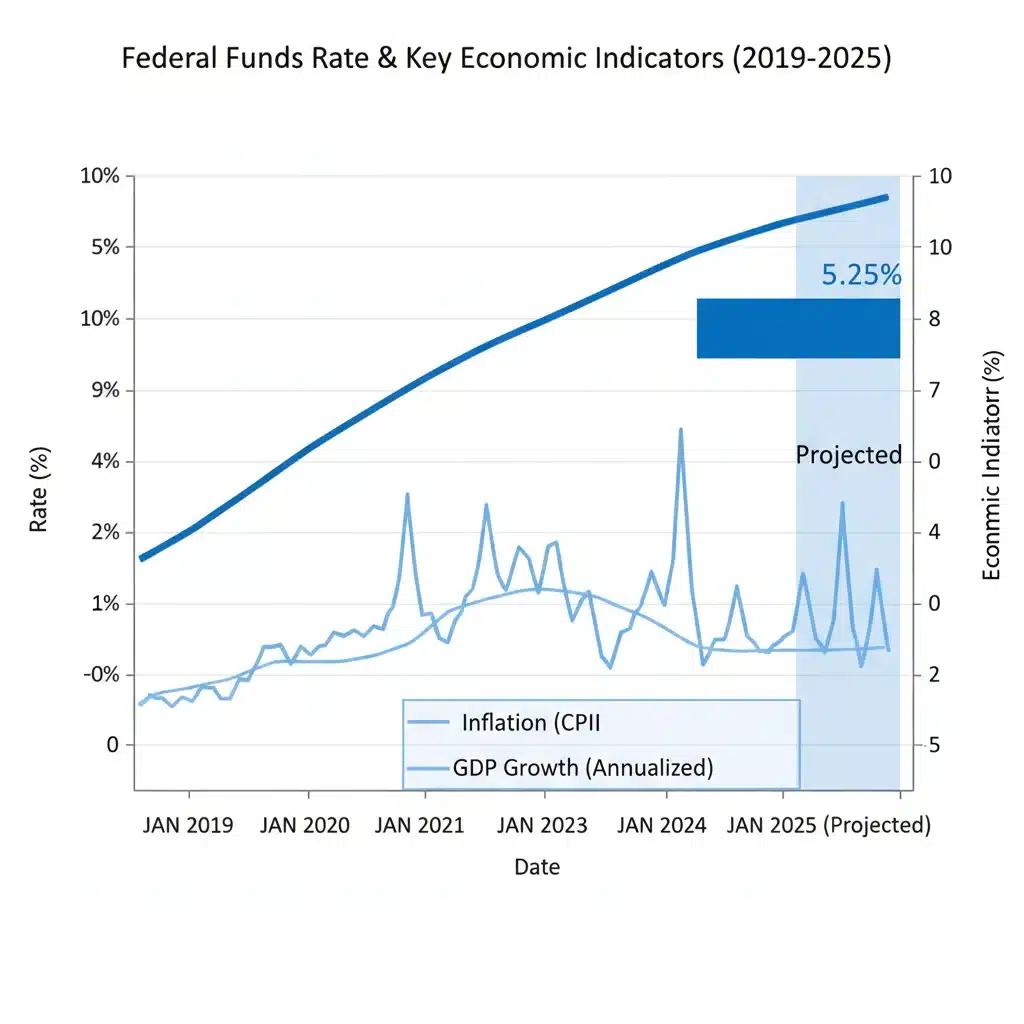
The FOMC’s choice to maintain Fed interest rates at 5.25% for the next half-year is predicated on a thorough review of several key economic indicators. These indicators provide a snapshot of the economy’s health and trajectory, guiding the central bank’s policy decisions. One of the most critical factors is inflation data. While the Consumer Price Index (CPI) and Personal Consumption Expenditures (PCE) price index have shown signs of cooling from their peaks, they still remain above the Fed’s long-term target of 2%. The deceleration, however, has been sufficient to convince the Fed that the current restrictive stance is adequate to continue pushing inflation downwards without the need for further rate hikes. The labor market is another pivotal indicator. Despite a series of rate increases, the U.S. labor market has remained remarkably resilient, with low unemployment rates and consistent job growth. However, recent data has indicated a gradual moderation in job openings and a slight increase in unemployment claims, suggesting a healthy rebalancing rather than a sharp downturn. This ‘soft landing’ scenario for the labor market is precisely what the Fed aims for: cooling demand without triggering mass layoffs. Gross Domestic Product (GDP) growth also plays a significant role. While some economists predicted a recession, the U.S. economy has largely defied expectations, demonstrating continued, albeit slower, growth. This sustained growth, coupled with moderating inflation, provides the Fed with the confidence that the economy can absorb the existing high interest rates without tipping into a severe contraction. Consumer spending, a major driver of economic activity, has also been closely monitored. Although there have been some signs of softening, overall consumer demand has held up, supported by solid wage growth and robust household balance sheets. The Fed is keen to ensure that its policies do not stifle this essential component of the economy too severely. Global economic conditions and geopolitical events also factor into the Fed’s calculus. Instability in other major economies or unforeseen international crises can impact U.S. economic prospects, influencing the Fed’s risk assessment and policy adjustments. By holding Fed interest rates steady, the FOMC is signaling that it believes the current economic landscape supports this period of stability, allowing time for previous policy interventions to fully permeate the system and for further data to confirm the desired economic trajectory. This data-driven approach is fundamental to the Fed’s strategy, ensuring that monetary policy remains responsive to evolving economic realities while maintaining a clear long-term objective of price stability and maximum employment.
Impact on Consumers and Businesses
The Federal Reserve’s decision to keep Fed interest rates at 5.25% for the next six months carries significant implications for both consumers and businesses across various sectors of the economy. For consumers, the most direct impact will be on borrowing costs. Mortgage rates, which are closely tied to the federal funds rate, are likely to remain elevated. This means that prospective homebuyers will continue to face higher monthly payments, potentially dampening housing market activity. Similarly, interest rates on credit cards, auto loans, and personal loans will also remain high, making it more expensive for individuals to finance purchases or consolidate debt. While this is a challenge for borrowers, savers may see a silver lining. High-yield savings accounts and Certificates of Deposit (CDs) will continue to offer attractive returns, providing an incentive for individuals to save more. However, the overall effect on consumer spending could be a slowdown, as higher borrowing costs and the desire to earn better returns on savings may lead to more cautious financial behavior.
For businesses, particularly small and medium-sized enterprises (SMEs), the sustained high Fed interest rates mean that the cost of capital will remain elevated. Companies looking to expand, invest in new equipment, or manage working capital will find borrowing more expensive. This could lead to a slowdown in business investment and hiring, as firms become more cautious about taking on new debt. Industries that are particularly sensitive to interest rates, such as real estate, construction, and manufacturing, may feel a continued pinch. Larger corporations with access to diverse funding sources might be less impacted, but even they will face higher financing costs for bond issuances and corporate loans. On the other hand, businesses that rely on strong consumer demand might see some softening as consumers tighten their belts. Companies with significant cash reserves, however, might find opportunities to acquire assets or make strategic investments from less financially robust competitors. The stability in rates, while high, does offer some predictability, allowing businesses to plan their financial strategies with a clearer understanding of their borrowing costs for the next six months. This period allows businesses to adjust their operational models, optimize their balance sheets, and potentially find efficiencies to mitigate the impact of higher interest expenses. The Fed’s consistent stance on Fed interest rates provides a window for strategic recalibration rather than reacting to volatile, unpredictable rate changes.
Implications for Financial Markets
Financial markets are inherently forward-looking, and the Federal Reserve’s statement on maintaining Fed interest rates at 5.25% for the next six months has already been largely priced in, yet it continues to shape investor sentiment and asset valuations. The bond market, in particular, reacts keenly to interest rate expectations. Treasury yields, which serve as benchmarks for other debt instruments, are expected to remain relatively stable, reflecting the Fed’s commitment to a steady rate environment. This stability can be a double-edged sword: it offers predictability for fixed-income investors but may limit significant capital gains from falling yields. Investors seeking higher returns might continue to favor shorter-duration bonds or high-yield corporate debt, albeit with increased risk.
The stock market’s reaction to sustained high Fed interest rates is often nuanced. While higher rates generally make borrowing more expensive for companies and can weigh on corporate earnings, the predictability offered by the Fed’s guidance can reduce market volatility. Growth stocks, which are often more sensitive to interest rates due to their reliance on future earnings, might continue to face headwinds. Value stocks, on the other hand, which are typically more mature companies with stable cash flows, might prove more resilient. Sectors such as banking and finance could see continued benefits from higher net interest margins, while highly leveraged industries might struggle. Furthermore, the U.S. dollar’s strength is often influenced by interest rate differentials. A sustained 5.25% rate might keep the dollar relatively strong against other major currencies, potentially impacting international trade and the competitiveness of U.S. exports. International investors might find U.S. assets more attractive due to higher yields, leading to capital inflows. The stability in Fed interest rates also provides clarity for portfolio managers and institutional investors, allowing them to adjust their strategies without the constant pressure of impending rate changes. This period of stability could encourage a shift towards more fundamental analysis rather than speculative plays based on rate hike expectations. The market will now focus more intently on corporate earnings, economic growth indicators, and geopolitical developments, rather than solely on the Fed’s next move. This shift could lead to a more rational and less volatile market environment over the next six months, assuming no major unforeseen economic shocks.

Future Outlook and Potential Scenarios for Fed Interest Rates
While the Federal Reserve has clearly communicated its intention to hold Fed interest rates at 5.25% for the next six months, the economic landscape is dynamic, and future policy decisions will remain data-dependent. Several potential scenarios could unfold, influencing the Fed’s actions beyond this initial six-month window. One scenario is that inflation continues its disinflationary trend, gradually moving closer to the 2% target. In this case, the Fed might begin to consider rate cuts towards the latter half of the year or early next year. Such a move would be aimed at preventing an overly restrictive monetary policy from stifling economic growth unnecessarily. Rate cuts would likely be welcomed by borrowers and could stimulate investment and consumer spending, providing a boost to the economy.
Conversely, if inflation proves to be more persistent than anticipated, or if there’s a resurgence in price pressures due to unforeseen supply shocks or stronger-than-expected demand, the Fed might be forced to reconsider its stance. In this scenario, the ‘higher for longer’ narrative could extend beyond the six-month projection, and in an extreme case, even further rate hikes might be on the table, though this is considered less likely given the current trajectory. Another possibility involves a significant weakening of the labor market or a more severe economic downturn than currently projected. If unemployment rises sharply or GDP contracts significantly, the Fed might be compelled to cut rates sooner than planned, even if inflation hasn’t fully reached its target. The central bank would then prioritize supporting employment and economic stability over strictly adhering to the inflation target in the short term. Geopolitical events, such as new conflicts or major disruptions to global supply chains, also pose a significant risk. Such events could introduce new inflationary pressures or dampen economic activity, forcing the Fed to adjust its policy. The Fed’s communication often emphasizes its flexibility and readiness to adapt to evolving economic conditions. While the current guidance provides a degree of certainty, it is crucial for market participants and the public to understand that this outlook is not set in stone. Continuous monitoring of economic data, global developments, and the Fed’s public statements will be essential to anticipate future shifts in Fed interest rates. The next six months will be a critical period for observing how the economy responds to the sustained 5.25% rate and for gathering the necessary evidence to inform the Fed’s subsequent monetary policy decisions, ultimately shaping the long-term economic trajectory.
Conclusion: Navigating the Steady Waters of Fed Interest Rates
The Federal Reserve’s decision to maintain Fed interest rates at 5.25% for the next six months marks a pivotal moment in the current economic cycle. After a period of aggressive tightening, this sustained pause signals a strategic shift towards assessing the cumulative impact of past actions and allowing the economy to adjust. For consumers, this means continued elevated borrowing costs for mortgages, auto loans, and credit cards, while savers can enjoy attractive returns on deposits. Businesses will need to navigate a higher cost of capital, potentially leading to cautious investment and hiring decisions, especially for SMEs. Financial markets, having largely priced in this stability, will now turn their attention to corporate earnings and fundamental economic data, rather than solely anticipating the next rate move, which could lead to a more stable yet less volatile environment.
The rationale behind this decision is deeply rooted in a data-driven approach, with the Fed carefully weighing inflation trends, labor market resilience, and overall economic growth. While there’s cautious optimism that inflation is moving towards the 2% target, the central bank remains vigilant against potential resurgences. Looking ahead, the economic landscape beyond the next six months remains subject to various scenarios, ranging from potential rate cuts if disinflation continues smoothly, to the possibility of ‘higher for longer’ if inflationary pressures persist, or even earlier cuts if a significant economic downturn materializes. Ultimately, this period of stable Fed interest rates at 5.25% offers a crucial window for the economy to absorb the impacts of previous policy, for businesses and consumers to adapt their financial strategies, and for the Federal Reserve to gather further evidence to guide its long-term monetary policy. Navigating these steady waters will require continued vigilance and adaptability from all economic participants, as the Fed remains committed to its dual mandate of price stability and maximum employment, shaping the financial future of the nation.